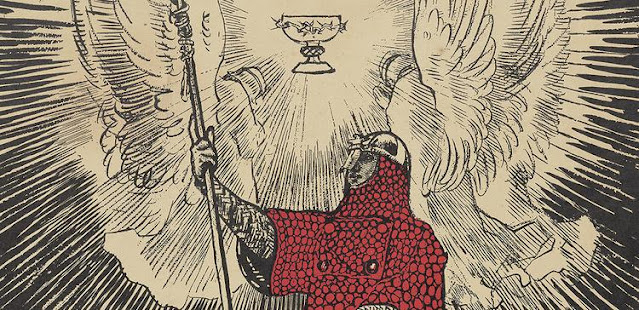
To me, methought, who waited with a crowd,
There came a bark that, blowing forward, bore
King Arthur, like a modern gentleman
Of stateliest port; and all the people cried,
"Arthur is come again: he cannot die."

"Morte d'Arthur" (1842)
Alfred, Lord Tennyson

Friday, June 14, 2024

New from D S Brewer - Arthurian Literature 39 for 2024

Arthurian Literature XXXIX: A Celebration of Elizabeth Archibald

Edited by Megan G Leitch and Kevin S Whetter


Full details, preview, and ordering information at https://boydellandbrewer.com/9781843847182/arthurian-literature-xxxix/.


TITLE DETAILS

190 Pages

23.4 x 15.6 cm

Series: Arthurian Literature

Series Vol. Number: 39

Imprint: D.S.Brewer


Hardcover

9781843847182

June 2024

£70.00 / $115.00 

(ebook also available)


DESCRIPTION

"Delivers fascinating material across genres, periods, and theoretical issues." TIMES LITERARY SUPPLEMENT

This volume is a special issue dedicated to Professor Elizabeth Archibald, who has had such an impact on, and made so many significant contributions to, the field of Arthurian Studies. It maintains its tradition of diverse approaches to the Arthurian tradition - albeit on this occasion with a particular focus on Malory, appropriately reflecting one of Professor Archibald's main interests.

It starts with the essay awarded this year's D.S. Brewer Prize for a contribution by an early career scholar, which considers the little-known debt owed by early modern sailors to Arthurian knighthood and pageantry. The essays that follow begin with a wide-ranging account of manuscript decorations and annotations in Geoffrey of Monmouth's Historia, before turning to the Evil Custom trope in Sir Gawain and the Green Knight. Further contributions explore the formalities of requests and conditions in Malory's '"Tale of Gareth", emotional excess and magical transformation in several scenes across the Morte Darthur, tensions between public and private and self and identity in Malory's "Sankgreal", and friction between the (external and imposed) law and (internal and subjective but honourable) code of chivalry, especially apparent in Malory's final Tales. The last article examines the ways in which Mordred's origins in modern Arthurian fiction build on Malory's false, or forgotten, promise to relate Mordred's upbringing. The volume closes with a short tribute to Elizabeth Archibald, highlighting her leadership in the field and her encouragement of scholarly collaboration and community.


CONTENTS

1. The Derek Brewer Essay Prize: Playing Arthur: Making the Elizabethan Mariner - Felicity Brown

2. Ignoring Arthur: Patterns of (In)Attention in Manuscripts of Latin Histories - Siân Echard

3. 'Þe place þat ȝe prece to ful perelous is halden': The Evil Custom in Sir Gawain and the Green Knight - David F. Johnson

4. 'aske bettyr, I counseyle the': Requests, Conditions, and Consent in Malory's 'Sir Gareth of Orkney' - Hannah Piercy

5. Supernatural Transformation in Malory's Le Morte Darthur - Natalie Jayne Goodison

6. Personal Piety and 'semyng outeward': Self and Identity in Thomas Malory's 'Tale of the Sankgreal' - Martha Claire Baldon

7. Evil Will and Shameful Death: Revisiting Law in Malory's Morte Darthur - Elizabeth Edwards

8. The Return of the Return of Mordred - Cory James Rushton


Recent from D S Brewer - Arthurian Literature 38 for 2023

Arthurian Literature XXXVIII

Edited by Kevin S Whetter and Megan G Leitch


Full details, preview, and ordering information at https://boydellandbrewer.com/9781843846475/arthurian-literature-xxxviii/.


TITLE DETAILS

342 Pages

23.4 x 15.6 cm

3 b/w

Series: Arthurian Literature

Series Vol. Number: 38

Imprint: D.S.Brewer

Hardcover


9781843846475

April 2023

£75.00 / $115.00 

(also available as an ebook)


DESCRIPTION

Arthurian Literature has established its position as the home for a great diversity of new research into Arthurian matters. It delivers fascinating material across genres, periods, and theoretical issues. TIMES LITERARY SUPPLEMENT


This issue offers stimulating studies of a wide range of Arthurian texts and authors, from the Middle Ages to the nineteenth century, among which is the first winner of the Derek Brewer Essay Prize, awarded to a fascinating exploration of Ragnelle's strangeness in The Weddyng of Syr Gawen and Dame Ragnelle. It includes an exploration of Irish and Welsh cognates and possible sources for Merlin; Bakhtinian analysis of Geoffrey of Monmouth's playful discourse; and an account of the transmission of Geoffrey's text into Old Icelandic. In the Middle English tradition, there is an investigation of material Arthuriana in Sir Gawain and the Green Knight, followed by explorations of shame in Malory's Morte Darthur. The post-medieval articles see one paper devoted to the paratexts of sixteenth-century French Arthurian publishers; one to eighteenth-century Arthuriana; and one to a range of nineteenth-century rewritings of the virginity of Galahad and Percival's Sister. Two Notes close this volume: one on Geoffrey's Vita Merlini and a possible Irish source, and one on a likely source for Malory's linking of Trystram with the Book of Hunting and Hawking in an early form of The Book of St Albans.


CONTENTS

1. Animals at the Feast: Strange Strangers and Courtly Power in The Wedding of Sir Gawain and Dame Ragnelle - C. M. Palmer

2. The Kindred of a Boy without a Father: Merlin's British Forebears and Irish Cousins -John Carey

3. Geoffrey of Monmouth's Subtle Subversion: Active Double-Voiced Discourse in the Historia regum Britanniae - Vanessa K. Iacocca

4. 'Cornwall, up in the North': Geography and Place Names in the Source of the Old Icelandic Brut - Hélène Tétrel

5. Enacting Arthurianism in the Order of the Garter and Sir Gawain and the Green Knight' - Matt Clancy

6. Deviants and Dissenters: Theorizing Shame and Punishment in Malory's Morte - Richard Sévère

7. Loyalty and Worshyp in Conflict in Malory's Lancelot - Manabu Agari

8. Emotional Inheritance in Malory's Morte Darthur: Shame and the Lott-Pellinore Feud - Karen Cherewatuk

9. Navigating and Indexing Arthurian Romance in Benoît Rigaud's Edition of Lancelot du Lake (1591) - Jane H. M. Taylor and Leah Tether

10. 'A great many strange puppets': Queen Caroline, Merlin's Cave, and Symbolic Arthurianism in the Age of Reason - Amy Louise Blaney

11. 'How Galahad Regained his Virginity: Dead Women, Catholicism, and the Grail in Nineteenth-Century British Poetry' - Kenneth Hodges

12. 'Merlin's Woodland House: Irish Cosmology in the Vita Merlini?' - Jennifer Lopatin and A. Joseph McMullen

13. Malory and the Book of St Albans - P. J. C. Field


Catching Up - Arthurian Literature 35 for 2020

Arthurian Literature XXXV

Edited by Elizabeth Archibald and David F. Johnson


Full details, previews, and ordering information at https://boydellandbrewer.com/9781843845454/arthurian-literature-xxxv/. 


TITLE DETAILS

227 Pages

23.4 x 15.6 cm

5 b/w illus.

Series: Arthurian Literature

Series Vol. Number: 35

Imprint: D.S.Brewer

Hardcover


9781843845454

June 2020

$115.00 / £75.00 (also available as an ebook)


DESCRIPTION

The continued influence and significance of the legend of Arthur are demonstrated by the articles collected in this volume.


The rich vitality of both the Arthurian material itself and the scholarship devoted to it is manifested in this volume. It begins with an interdisciplinary study of swords belonging to Arthurian and other heroes and of the smiths who made them, assessed both in their literary contexts and in "historical" references to their existence as heroic relics. Two essays then consider the use of Arthurian material for political purposes: a discussion of Caradog's Vita Gildae throws light on the complex attitudes to Arthur of contemporaries of Geoffrey of Monmouth in a time of political turmoil in England, and an investigation into borrowings from Geoffrey's Historia in a chronicle of Anglo-Scottish relations in the time of Edward I, a well-known admirer of the Arthurian legend, argues that they would have appealed to the clerical élite. Romance motifs link the subsequent pieces: women and their friendships in Ywain and Gawain, the only known close English adaptation of a romance by Chrétien, and the mixture of sacred and secular in The Turke and Gawain, with fascinating alchemical parallels for a puzzling beheading episode. This is followed by a discussion of the views on native and foreign sources of three sixteenth-century defenders of Arthur, John Leland, John Prise and Humphrey Llwyd, and their responses to the criticisms of Polydore Vergil. In twentieth-century reception history, John Steinbeck was an ardent Arthurian enthusiast: an essay looks at the significance of his annotations to his copy of Malory as he worked on his adaptation, The Acts of King Arthur and his Noble Knights. The volume moves to even more recent territory with an exploration of the adaptations of Malory and other Arthurian writers that occur in the comic books by Geoff Johns about Arthur Curry, aka Aquaman, King of Atlantis. The book is completed by a reprint of a classic essay by Norris Lacy on the absence and presence of the Grail in Arthurian texts from the twelfth century on.


CONTENTS

Arthurian Swords I: Gawain's Sword and the Legend of Weland the Smith - Richard Barber

Rex rebellis et vir pacificus: Civil War and Ecclesiastical Peacekeeping in the Vita Gildae of Caradog of Llancarfan - Andrew Rabin

Once and Future History: Textual Borrowing in an Account of the First War of Scottish Independence - Christopher Michael Berard

'Me rewes sore': Women's Friendship, Affect and Loyalty in Ywain and Gawain - Usha Vishnuvajjala

The Sacred and the Secular: Alchemical Transformation in The Turke and Sir Gawain - Natalie Goodison

'The native place of that great Arthur': Foreignness and Nativity in Sixteenth-Century Defences of Arthur - Mary Bateman

John Steinbeck's 'Wonder-Words' - Elaine Treharne and William J. Fowler

The Once and Future King of Atlantis: The Arthurian Figure in Geoff Johns's Aquaman: Death of a King - Carl B. Sell

Arthur and/or the Grail - Norris J. Lacy


Thursday, May 2, 2024

Arthuriana for Spring 2024

The latest number of Arthuriana is out. Access can be gained by subscription to the journal or from Project Muse. Contents follow. 


Table of Contents 

(34.1) (Spring 2024)

‘Bi þat watz Gryngolet grayth and gurde with a sadel’: Characterizing Gringolet in Old French and Middle English Romances 

Marisa Mills


‘The forme to the finisment fuldes ful selden’: A Comparison of David Lowery’s Screenplay and His 2021 Film Adaptation The Green Knight 

Dennis Tredy 


* THE 2023 LOOMISES LECTURE * 


Environmental Realism in the Arthurian Forest of Adventure.

Michael W. Twomey 


ANNOUNCEMENTS


An Invitation to Consider a Potential Arthur-Figure Memorial Stone.  

Guye Pennington 


THE ROUND TABLE: NEWS FROM THE IAS-NAB                                                                                


REVIEWS


Gillian Adler and Paul Strohm, Alle Thyng Hath Tyme: Time and Medieval Life 

Marie Schilling Grogan 


Gloria Allaire and Julie Human, eds., Courtly Pastimes

Tara Foster 


Jeffrey John Dixon, Encyclopedia of the Holy Grail 

Phillip C. Boardman 


Elis Gruffydd, Tales of Merlin, Arthur, and the Magic Arts: From the Welsh Chronicle of the Six Ages of the World 

Peter H. Goodrich 


Annegret Oehme, The Knight Without Boundaries: Yiddish and German Arthurian Wigalois Adaptations 

Jonathan Seelye Martin 


Joseph Taylor, Writing the North of England in the Middle Ages: Regionalism and Nationalism in Medieval English Literature 

Ann M. Martinez 


Marion Turner, The Wife of Bath: A Biography 

Kathleen Forni  


Christopher Vaccaro, ed., Painful Pleasures: Sadomasochism in Medieval Cultures 

 James C. Staples


Monday, April 29, 2024

Notice Re-Creating Camelots at Kalamazoo 2024

Re-Creating Camelot? Community-Building in Arthurian Studies (A Roundtable) (Virtual)


59th International Congress on Medieval Studies (you must register to attend)

Western Michigan University (Kalamazoo, MI)

Virtual Session

Session 474: Saturday, 11 May 2024, from 3:30 PM - 5:00 PM


Co-Sponsored by Alliance for the Promotion of Research on the Matter of Britain and

International Arthurian Society, North American Branch (IAS/NAB)


Co-Organizers: Michael A. Torregrossa, Bristol Community College, and Joseph M. Sullivan, Univ. of Oklahoma


Presider: Carl B. Sell, Univ. of Pittsburgh 


(This session will be recorded.)

Paper 1:

“There Are One or Two Changes I'd Like You to Consider”: The Elusive Attempts to Revise Lerner and Lowe’s Camelot in Contemporary America

Jarrod DePrado, Sacred Heart University 


Pronouns: He/Him/His


Jarrod DePrado is an instructor at Sacred Heart University in the Departments of Languages & Literature and Catholic Studies. He received his graduate degree from Boston University in English and American Literature. His area of specialization is transhistorical drama—bridging Shakespeare, 20th- & 21st-Century American Drama, and musical theatre—with a focus on adaptation studies and American politics. He will begin his PhD in English at the University of Connecticut in the Fall.


Paper 2:

Tournament of "Diversity": Inclusion, Expulsion and Panic
Tirumular (Drew) Narayanan, University of Wisconsin-Madison


Pronouns: He/Him/His


Drew Narayanan is a PhD Candidate in Art History at the University of Wisconsin–Madison. His dissertation project focuses on the “Sultan of Babylon” as historical and fantastical racialized construction in 14th and 15th century Latin Christian manuscripts. He has also won a prize for his peer-reviewed article titled “Sir Palamedes the Indelibly ‘Saracen’ Knight: Heraldry, Monstrosity, and Race in Fifteenth-Century Arthurian Romance Manuscripts.”


Paper 3:

“(Re)creating Camelot:  Scholars, Networks, and the Academy”
Richard Utz, Georgia Institute of Technology


Pronouns: he, him, hine, hisse, hes, him-seluen


Richard Utz is Professor of Medievalism Studies and Interim Dean in the Ivan Allen College of Liberal Arts at Georgia Tech. His contributions to the Roundtable topic include "The Chameleon Principle: Reflections on the Status of Arthurian Studies in the Academy," Arthuriana (2007) and Medievalism: A Manifesto (2017).


Notice Creating Camelots at Kalamazoo 2024

Creating Camelot(s): The Idea of Community in Arthurian Texts (Virtual)


59th International Congress on Medieval Studies (you must register to attend)

Western Michigan University (Kalamazoo, MI)

Virtual Session

Session 425: Saturday, 11 May 2024, from 1:30 PM - 3:00 PM


Co-Sponsored by Alliance for the Promotion of Research on the Matter of Britain and

International Arthurian Society, North American Branch (IAS/NAB)


Co-Organizers: Michael A. Torregrossa, Bristol Community College, and Joseph M. Sullivan, Univ. of Oklahoma


Presider: Karen Casey Casebier, Univ. of Tennessee–Chattanooga 

(This session will be recorded.)


Paper 1:

Kissing King Arthur: The Threat of Discord in Chrétien's Erec et Enide and Hartmann's Erec

Jennifer Schmitt Carnell, Hill Museum and Manuscript Library 


Dr. Jennifer Carnell (she/her) earned her doctorate last year at the University of Minnesota in the Twin Cities. She then began working for the Hill Museum and Manuscript Library near St. Cloud, Minnesota, where she is updating their catalog of microfilms of Western medieval manuscripts housed in German libraries. Jenn’s dissertation is a close reading of the role of communal expressions of joy in medieval German literature, and today’s presentation has been developed from one of the chapters.


Paper 2:

Worship and Noyse: Chivalric Identity and the Formation of Emotional Communities in Malory's Morte Darthur

Victoria E Dikeman, Ohio State Univ. 

Victoria Dikeman (she/her) is a PhD candidate at The Ohio State University. Her research focuses on Arthurian literature. Currently, she is completing her dissertation on reputation and gossip in Thomas Malory’s Morte Darthur.


Paper 3:

The Broadway 2023 Camelot Revival: A Hollow Retelling of the Legend?

Hope E Koonin, Independent Scholar 


Hope Koonin is an independent scholar. She graduated in 2023 from UC Davis with a Bachelor of Arts in English. She is interested in the study and history of fantasy literature.


Thursday, April 18, 2024

CFP Tradition and Innovation in Sir Gawain and the Green Knight Conference (4/20/2024; Nancy, France/hybrid 11/21-22/2024)

CFP: Tradition and Innovation in Sir Gawain and the Green Knight


Source: https://medievalisms.org/cfp-tradition-and-innovation-in-sir-gawain-and-the-green-knight/


We are pleased to announce a call for papers for an upcoming conference on “Tradition and Innovation in Sir Gawain and the Green Knight,” to be held in Nancy (France) on 21-22 November 2024. This conference will be held in hybrid mode.

Conference Theme: Sir Gawain and the Green Knight has captivated readers for centuries with its complex narrative, moral dilemmas, and poetic excellence. The conference seeks to explore the dynamic interplay between tradition and innovation within the text, examining how the poem, but also the works derived from it and the scholarship devoted to it, draw upon established traditions while introducing novel elements.

The first axis of our inquiry focuses on the poem itself. While it is steeped in the traditions of Arthurian romance and Middle English poetry, Sir Gawain and the Green Knight departs from them and frustrates expectations in significant ways, both in terms of its content and its form. This exploration aims to shed light on the creative ways in which Sir Gawain and the Green Knight navigates established literary norms, both adhering to tradition and introducing innovative elements within its narrative structure and thematic content.

The second axis of our inquiry focuses on the many works inspired by Sir Gawain and the Green Knight. This includes rewritings, translations, and visual interpretations that grapple with the tension between fidelity to the original and the impulse to reimagine the narrative within contemporary contexts. From modern language adaptations to artistic representations, we seek to understand how the poem’s essence endures through the transformative lens of subsequent generations.

We invite proposals for individual papers (20 minutes). Please submit abstracts (250-300 words) along with a brief bio to Colette.Stevanovitch@univ-lorraine.fr by 20 April. Include your name, institutional affiliation, contact information, and any audiovisual requirements.

Monday, April 8, 2024

Visualizing Arthur April 2024 Events and Flier

Forwarded on behalf of Barbara Tepa Lupack:

Download the flier here. 

Download the postcard here.


◄ For Immediate Release ►


Visualizing Camelot


An Exhibition from the Collection of Drs. Alan Lupack and Barbara Tepa Lupack


At the University of Rochester


Visualizing Camelot, a University of Rochester River Campus Libraries exhibition from the collection of Drs. Alan Lupack and Barbara Tepa Lupack, explores the ongoing appeal of the Arthurian legends in England and America. The exhibition—which opened on March 7, 2024, with remarks from the Lupacks, a reception, and a tour of the exhibition—reveals the diverse ways that the stories of Camelot have been imagined and visualized, both in high culture (paintings, drawings, illustrated books) and in popular culture (film, toys, games, comic books, cartoons, dishware, product names, business logos, etc.). The exhibition, which includes more than 350 items (many of them unique), runs from the first to the fourth floor of Rush Rhees (from the Friedlander Lobby to Rare Books, Special Collections, and Preservation and to the Robbins Library). Visualizing Camelot is free and open to all, and a wide array of programming relating to the exhibition is planned throughout 2024.

Among the opening week’s events was a presentation by Dr. Kevin Whetter, Acadia University, on “Why Are There So Few Illustrations in Mediaeval English Arthurian Manuscripts? The Non-Visual Camelot.” 

Upcoming spring events include a five-film Arthurian Film Series hosted by the Eastman Museum’s Dryden Theatre in collaboration with the exhibition. That series will include A Connecticut Yankee in King Arthur’s Court (1949), on April 6; Knights of the Round Table (1953), on April; 11; The Sword in the Stone (1963), on April 19; Monty Python and the Holy Grail (1975), on April 25; and Excalibur (1983), on May 5. For more information on the series, please go to Dryden Theatre | George Eastman Museum


Upcoming next month is a presentation by Dr. Kevin J. Harty, La Salle University, on April 19. Dr. Harty’s topic is “James Bond, A Grifter, A Video Avatar, and a Shark Walk into King Arthur’s Court: The Ever-Expanding Canon of Cinema Arthuriana.” The presentation will also be livestreamed. If interested, please register at the following link:

https://docs.google.com/forms/d/1Lr0nRKZLfJZQl3ynshHWUWiHu1I3o6vG07-fkbaKOgY/edit

(or contact Dr. Anna Siebach-Larsen at annasiebachlarsen@rochester.edu.)

A digital exhibit Visualizing Camelot and an exhibition catalogue will follow by the end of April. A host of other activities and events are scheduled for summer and fall, 2024.

We hope that you will join us, in person or on-line, to tour Visiting Camelot and to participate in some of the exhibition events.


About the Lupacks

Dr. Alan Lupack, a noted Arthurian scholar and former director of the Robbins Library, is author or editor of numerous Arthurian studies, including Arthur, The Greatest King; Arthurian Drama; Modern Arthurian Literature; New Directions in Arthurian Studies; and The Oxford Guide to Arthurian Literature and Legend.

Dr. Barbara Tepa Lupack, the former academic dean at SUNY and New York State Public Scholar (2015-2018), is author or editor of more than 25 books, including The Girl’s King Arthur; King Arthur’s Crown; Adapting the Arthurian Legends for Children; and the recently published The Othering of Women in Silent Film.

The Lupacks have lectured and published widely on Arthurian topics. Together, they created The Camelot Project, a popular and award-winning database of texts, images, and information about the Arthurian legends, and coauthored studies such as Arthurian Literature by Women, Illustrating Camelot, and the award-winning King Arthur in America.

For More Information About the Exhibition: please contact Anna Siebach-Larsen, Director of the Robbins Library, at annasiebachlarsen@rochester.edu.


Wednesday, March 20, 2024

Out Now - Roman de Brut in Oxford Worlds Classics Edition


Roman de Brut

Wace
Translated by Glyn S. Burgess and with an Introduction and Notes by Jean Blacker

Full details from the publisher's website at https://global.oup.com/academic/product/roman-de-brut-9780192871268.

Paperback

Published: 11 April 2024

320 Pages

7.7 x 5.1 inches

ISBN: 9780192871268

Oxford World's Classics


A new translation of Wace's Roman de Brut, a poem which served as a gateway to the larger traditions of Arthurian literature and historical writing in the French and English vernaculars

Provides an easily accessible English prose translation of the first complete Old French adaptation (1155) of Geoffrey of Monmouth's History of the Kings of Britain (c. 1130-40), in which Arthur appears for the first time as king of the Britons

Accompanied by extensive critical apparatus, including a summary of the text, a glossary, a list of manuscripts, and an index of personal and geographical names


Description


'Whoever wishes to hear about, and to know about, kings and heirs, about who first ruled England and which kings it had, Master Wace, who is telling the truth about this, has translated this.'

Wace's Roman de Brut (1155) can be seen as the gateway to the history of the Britons for both French and English speakers of the time, and thus to Arthurian history, as the first complete Old French adaptation of Geoffrey of Monmouth's Latin History of the Kings of Britain (late 1130s), in which Arthur appears for the first time as king of the Britons. The Roman de Brut was a foundational work, an inspiration for a series of anonymous verse Bruts of the late twelfth and thirteenth centuries and for the Anglo-Norman Prose Brut -- the most widely read French vernacular text on this material in medieval England -- as well as a forerunner of the Middle English Brut tradition, including Layamon's Brut (c. 1200). Wace's poem thus inaugurates and shapes Brut traditions, including Arthurian tales, in verse and in prose, in historiography and in literature, including Wace's innovation of King Arthur's Round Table.

This volume contains an English prose translation of Wace's Roman de Brut, accompanied by an introduction and notes, a select bibliography, a summary of the text, a list of manuscripts, and indexes of personal and geographical names.


Author Information

Glyn S. Burgess is Emeritus Professor of French at the University of Liverpool. He has translated the three twelfth-century romances of antiquity and the Roman de Rou of Wace (2002). In 1990 he was made a Chevalier des Palmes Académiques and he is an honorary President of the International Courtly Literature Society. His most recent books are Twenty-Four Lays from the French Middle Ages (2016; with Leslie C. Brook), The Roman de Troie by Benoît de Sainte-Maure (2017; with Douglas Kelly), and The Roman de Thèbes and the Roman d'Eneas (2021; with Douglas Kelly).

Jean Blacker is Emeritus Professor of French, Kenyon College. Her more recent publications include Wace, The Hagiographical Works: The Conception Nostre Dame and the Lives of St Margaret and St Nicholas (2013), with Glyn S. Burgess, and Amy V. Ogden, Court and Cloister: Essays in the Short Narrative in Honor of Glyn S. Burgess (2018), with Jane H. M. Taylor. Her work focuses on the protean uses of King Arthur in Anglo-Norman, Continental French, and Latin historiography of the twelfth and thirteenth centuries, focusing on the interconnections between foundation myths, competing claims of identity, and cultural imperialism in the legendary history of Britain.

Saturday, February 17, 2024

JIAS 2023

The latest volume of the Journal of the International Arthurian Society. Access is available for purchase from the publisher. 


Journal of the International Arthurian Society

Volume 11 Issue 1

September 2023


Publicly Available September 7, 2023

Titelseiten

Page range: i-iv
Download PDF


Open Access September 7, 2023

‘Que nus contes de ce n’amende’: Chrétien de Troyes and the assertion of copyright

Keith Busby, Leah Tether
Page range: 1-18
More 
Download PDF

Requires Authentication September 7, 2023

Acheflour and Blauncheflour: Mothers and Wives in Sir Percyvell of Galles and Sir Tristrem

Aude Martin
Page range: 45-59
More 

Requires Authentication September 7, 2023

Petrine Failings and Broken Pentangles: Sir Gawain and the Green Knight’s Chivalric Felix Culpa

Arielle McKee
Page range: 60-82
More 

Requires Authentication September 7, 2023

Eric fighting in Guatemala. Adaptation and proximation of medieval Arthurian literature in Manuel Vázquez Montalbán’s Erec y Enide

Carlos Sanz Mingo
Page range: 83-104
More 

Requires Authentication September 7, 2023

Von den nahtweiden. Mythologische Subtexte in der Crône Heinrichs von dem Türlin

Christoph Schanze
Page range: 105-128
More 

Requires Authentication September 7, 2023

The Transmedial Knights of the Round Table: Character-Based Worldbuilding in the Manuscripts of Chrétien de Troyes

Caitlin G. Watt
Page range: 129-151
More 

Obituary

Requires Authentication September 7, 2023

Mary Dewey (1947–2023)

Linda Gowans, Alison Rawles
Page range: 152-153

Requires Authentication September 7, 2023

Gilles Eckard (1949–2022)

Alain Corbellari
Page range: 154-155

Requires Authentication September 7, 2023

Amanda Hopkins (1962–2022)

Emma Campbell
Page range: 156-157

Requires Authentication September 7, 2023

Freda Humble (1922–2022)

Sue Bennett, Linda Gowans
Page range: 158-158

Requires Authentication September 7, 2023

Ian Lovecy (1947–2022)

P. J. C. Field
Page range: 159-160

Requires Authentication September 7, 2023

Roger Simpson (1938–2022)

Alan Lupack, Barbara Tepa Lupack, Kevin J. Harty
Page range: 161-162


Notices

Requires Authentication September 7, 2023

XXVIIth International Arthurian Congress, Aix-en-Provence, France, 11–18 July 2024

Page range: 163-163

Requires Authentication September 7, 2023

Biennial JIAS Essay Prize Competition 2024–25

Page range: 164-164