To me, methought, who waited with a crowd,
There came a bark that, blowing forward, bore
King Arthur, like a modern gentleman
Of stateliest port; and all the people cried,
"Arthur is come again: he cannot die."

"Morte d'Arthur" (1842)
Alfred, Lord Tennyson

Showing posts with label New Fiction. Show all posts

Friday, July 30, 2021

Online Event: SWORD STONE TABLE: King Arthur’s Court Reenvisioned 8/3/2021

Hoping this works. The original is complex.


SWORD STONE TABLE: King Arthur’s Court Reenvisioned

August 3 • 7:00 pm - 8:00 pm
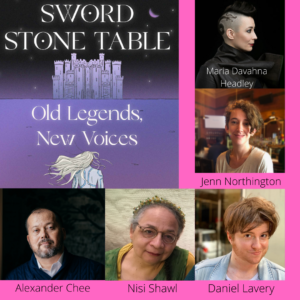


Featuring Sword Stone Table: Old Legends, New Voices editor Jenn Northington and contributors Alexander Chee, Maria Davahna Headley, Daniel Lavery and Nisi Shawl in conversation with Dr. Dorsey Armstrong

With A Connecticut Yankee in King Arthur’s Court, Mark Twain gave his own time travel twist to the Arthur legend. With Sword Stone Table, a whole new generation of writers bring their own takes on Arthur, Merlin, Mordred, Guinevere ,and Lancelot.

From the vast lore surrounding King Arthur, Camelot, and the Knights of the Round Table, comes an anthology of gender-bent, race-bent, LGBTQIA+ inclusive retellings. Here you’ll find the Lady of the Lake reimagined as an albino Ugandan sorceress and the Lady of Shalott as a wealthy, isolated woman in futuristic Mexico City; you’ll see Excalibur rediscovered as a baseball bat that grants a washed-up minor leaguer a fresh shot at glory and as a lost ceremonial drum that returns to a young First Nations boy the power and the dignity of his people. There are stories set in Gilded Age Chicago, ’80s New York, twenty-first century Singapore, and space; there are lesbian lady knights, Arthur and Merlin reborn in the modern era for a second chance at saving the world and falling in love—even a coffee shop AU.

Brave, bold, and groundbreaking, the stories in Sword Stone Table will bring fresh life to beloved myths and give long-time fans a chance to finally see themselves in their favorite legends.

Sword Stone Table features stories by:

Alexander Chee • Preeti Chhibber • Roshani Chokshi • Sive Doyle • Maria Dahvana Headley • Ausma Zehanat Khan • Daniel M. Lavery • Ken Liu • Sarah MacLean • Silvia Moreno-Garcia • Jessica Plummer • Anthony Rapp • Waubgeshig Rice • Alex Segura • Nisi Shawl • S. Zainab Williams

FREE program, but donations are gratefully accepted. REGISTER HERE.

Copies of Sword Stone Table signed by the editorsare available for purchase through the Mark Twain Store; proceeds benefit The Mark Twain House & Museum. Books will be shipped after the event. We regret that we are NOT able to ship books outside the United States as it is cost-prohibitive to do so.

————————–

About the Editors & Authors:

Swapna Krishna: https://www.swapnakrishna.com/bio

Jenn Northington: https://jennirl.com

Alexander Chee: https://www.alexanderchee.net

Maria Davahna Headley: https://www.mariadahvanaheadley.com

Nisi Shawl: http://www.nisishawl.com

Daniel Lavery: https://slate.com/author/danny-m-lavery


Our moderator: Professor Dorsey Armstrong


Professor Dorsey Armstrong—a specialist in medieval English literature—joined the Purdue faculty in 2002, where she currently serves as Head of the English Department. The holder of an A.B. in English and Creative Writing from Stanford University and a Ph.D. in Medieval Literature from Duke University, she also taught at Centenary College of Louisiana and at California State University, Long Beach. Her research interests include medieval women writers, late-medieval print culture, and the Arthurian legend, on which she has published extensively. In addition to numerous articles published in journals such as Exemplaria and Arthurian Literature, chapters in various academic books, and serving as co-editor for several scholarly essay collections, she is the author of Gender and the Chivalric Community in Malory’s Morte d’Arthur (University Press of Florida, 2003), Sir Thomas Malory’s Morte Darthur: A New Modern English Translation Based on the Winchester Manuscript (Parlor Press, 2009) and Mapping Malory: Regional Identities and National Geographies in Le Morte Darthur (Palgrave Macmillan, 2014; co-authored with Kenneth Hodges). In January 2009, she became editor-in-chief of the academic journal Arthuriana, which publishes the most cutting-edge research on the legend of King Arthur, from its medieval origins to its enactments in the present moment.

Winner of numerous teaching awards—including Purdue’s Murphy Award for Excellence in Undergraduate Instruction—Professor Armstrong has also written and taped several lecture series for The Teaching Company/The Great Courses. These include: “The Medieval World”; “Turning Points in Medieval History”; “Analysis and Critique: How to Engage With and Write About Anything”; “Great Minds of the Medieval World”; “1215: A Year That Changed History”; “King Arthur: History and Legend”; and “The Black Death: the World’s Most Devastating Plague.” Additionally, she has produced two short lecture series for Audible–one on “Powerful Medieval Women” and another on “Medieval Myths and Mysteries.” She currently sits on the executive and advisory boards for numerous scholarly and academic entities, the Bonnie Wheeler Fellowship, and the International Arthurian Society. She is currently at work editing a volume on Approaches to Teaching the Arthurian Tradition for the Modern Language Association.


Programs at The Mark Twain House & Museum are made possible in part by support from the Connecticut Department of Economic and Community Development, Office of the Arts, and the Greater Hartford Arts Council’s United Arts Campaign and its Travelers Arts Impact Grant program, with major support from The Travelers Foundation. For more information call 860-247-0998 or visit marktwainhouse.org

Saturday, July 10, 2021

Guest Post - Mediavilla on Legendborn

Deonn, Tracy. Legendborn. Margaret K. McElderry Books, 2020. The Legendborn Cycle 1. 501 pages. Hardcover: $18.99, ISBN 9781534441606.


Bree Matthews, a Black sixteen-year-old high-schooler, is about to start a pre-college residential program at UNC-Chapel Hill when she becomes embroiled in the machinations of a secret society, called “Legendborn,” made-up of students who are all blood descendants of King Arthur and his most trusted Knights of the Round Table. The Legendborn are on the verge of fighting an epic good-vs.-evil battle, known as Camlann, coming soon to campus. But not all is as it seems. The more Bree learns about the Legendborn, the more she suspects a connection to her mother’s recent death and so, with the help of Nick Davis, Arthur’s heir apparent, begins to investigate the group’s darker magical side. Along the way, she discovers her own magical powers, called “rootcraft,” which she traces back to her enslaved ancestors.


To become more familiar with the Legendborn ethos, Bree decides to train as a squire and, in so doing, becomes romantically involved with Nick. She also suddenly finds herself strangely attracted to Selwyn, Nick’s “Merlin” and protector, who recognizes in her a kindred spirit. Could Bree be destined to play an important role in the upcoming battle of Camlann even though she is not Legendborn?


Though overly complicated, the majority of the story is conveyed through dialog and so moves rather quickly. Nevertheless, the nearly 500-page book is too long by half, especially whenever Bree is tutored on the history of the Legendborn. Too much extraneous detail that, in the long run, has little to do with the plot. Furthermore, unlike other recent young adult novels set in Arthurian times, Legendborn takes place in the present-day, which demands more than a passing suspension of disbelief. Do the residents of UNC truly not hear the climactic battle that occurs on campus at the end of the book? And how does Bree find time to study between falling in love with Nick and training to become a squire?


Still, the novel remains compelling thanks to the author’s mostly subtle nods to the racial disparity Bree encounters as she struggles to become part of Nick’s all-too-White world. Ultimately, this is a contemporary—and extremely timely—parable about White privilege, told through the first-person eyes of a Black teenager descended from slaves. As Bree is acutely aware, the only people of color she sees at the Legendborn’s lodge are the servants who work for the students. Though she does not try to intentionally shatter the group’s color barrier, this is exactly what she eventually does. Looking gorgeous in a borrowed gown, she approaches the upscale club where a posh Legendborn gala is being held. “All right, sis,” the appreciative Black doorman says. They then knowingly smile at each other as Bree triumphantly enters the event (p. 401).


An “Instant New York Times Bestseller,” Legendborn was named to several “best books” lists of 2020/21, including YALSA (Young Adult Library Services Association), School Library Journal, Bookpage, New York Public Library, Indigo, BuzzFeed, and Amazon. Plus was named the winner of the American Library Association’s Coretta Scott King “John Steptoe Award for New Talent” in 2021. This book is recommended for all readers who enjoy contemporary adaptations of the Arthurian canon. A Legendborn sequel is in the works.


Cindy Mediavilla


Cindy Mediavilla is a retired public librarian who has collected, read and written about Arthurian fiction for more than 40 years. Her publications include Arthurian Fiction: An Annotated Bibliography (Scarecrow Press, 1999), "From 'Unthinking Stereotype' to Fearless Antagonist: The Evolution of Morgan le Fay on Television" (Arthuriana 25:1), and an article on Arthurian romance in Encyclopedia of Romance Fiction (2018). Cindy's MLS and PhD are from UCLA, where she also taught as a lecturer for 16 years.


Monday, February 1, 2021

Guest Post: Mediavilla on The Camelot Rising Trilogy, Books 1 and 2


White, Kiersten. The Guinevere Deception.  Delacorte Press, 2019. The Camelot Rising Trilogy 1. 339 pages. Hardcover: $18.99, ISBN: 9780525581673. Paperback: $10.99, ISBN: 9780525581703.


 - - -. The Camelot Betrayal. Delacorte Press, 2020. The Camelot Rising Trilogy 2. 370 pages. Hardcover: $18.99, ISBN: 9780525581710. 


Guinevere is 16 years old when she marries Arthur, two years her senior. Though they have never met, the king welcomes her with open arms while the people of Camelot look on and cheer. Still, nothing is as it seems. As soon becomes apparent, theirs is merely a marriage of convenience arranged by Arthur’s mentor, Merlin, who was banished from Camelot many years before. Instead of a “real wife,” Guinevere, who has magical powers of her own, was sent by Merlin to protect the king from his enemies. Instead of saving Arthur, however, Guinevere is, more often than not, the one needing rescue as she foolishly follows her misguided impulses into danger in hopes of foiling threats against the king. Coming to her aid is usually Arthur’s older nephew Mordred, an enigmatic character for whom the queen finds herself having inexplicable feelings.
 
In a recent online bookstore event, bestselling author Kiersten White proclaimed that, because every Arthurian writer adds his or her own spin to the legend, there no longer is an Arthurian “canon.” Indeed, she herself takes every opportunity to shatter tradition by introducing unexpected plot elements. The Tristan-Isolde-Mark love triangle, for instance, is depicted here as a secret romance between Isolde and her handmaid Brangien. Likewise, Lancelot, the queen’s knight, is eventually revealed to be a woman, who may or may not be in love with Guinevere. As for Arthur, before marrying the queen, he had a short-lived affair with Elaine, the sister of Maleagant, who kidnaps Guinevere to avenge Elaine’s death during childbirth. The names may be the same, but White obviously takes pleasure in adding her own special twist to an age-old saga.
 
Although both books are written in third-person, all action is seen and interpreted (often wrongly) through Guinevere’s naïve eyes. One might think the point here is to view the usually male-dominated story through a strong feminist lens. But with Arthur constantly gone, managing the business of Camelot, Guinevere is mostly left to her own ill-conceived devices that usually lead to trouble. Instead of an intelligent, masterful heroine, the reader is left with a young, inexperienced queen who listens to her heart more than she does common sense—resulting, not surprisingly, in yet another abduction at the end of the second book, setting the scene for the trilogy’s third volume, The Excalibur Curse, due to be published in 2021.
 
Lots of unanswered questions one hopes will be resolved by the end of book #3: Who exactly is Guinevere? Is Merlin good or evil? Which side is Mordred on? And will Arthur and the queen finally consummate their marriage? Recommended for young adults who are unfamiliar with the traditional Arthurian story.
 
 
Cindy Mediavilla
 
Cindy Mediavilla is a retired public librarian who has collected, read and written about Arthurian fiction for more than 40 years. Her publications include Arthurian Fiction: An Annotated Bibliography (Scarecrow Press, 1999), "From 'Unthinking Stereotype' to Fearless Antagonist: The Evolution of Morgan le Fay on Television" (Arthuriana 25:1), and an article on Arthurian romance in Encyclopedia of Romance Fiction (2018). Cindy's MLS and PhD are from UCLA, where she also taught as a lecturer for 16 years.
 

Saturday, January 16, 2021

Guest Post: Dan Nastali Reviews By Force Alone

Tidhar, Lavie. By Force Alone. Tor/Tom Doherty Books, 2020. 416 pages, $27.99. ISBN: 9781250753458.

This is a dark fantasy novel that retells the traditional Arthurian story, from Uther Pendragon’s taking the kingship of Britain to Arthur’s final battle at Camlann, with incidents and characters drawn from a wide range of medieval sources. Here you will find new treatments of the familiar figures at every turn, but unless your tastes run to the grim and gory, you may have some difficulty digesting this version. The story is set in a post-Roman Britain more fully conceived than that of most Dark Age historical and fantasy novels, and the action shifts, not always smoothly, between the natural and supernatural worlds. Both offer more than a little gratuitous ugliness in the form of mutilation, murder, cannibalism, general bad behavior and rather too much excrement.

The McGuffin in this story is the grail—here a skystone or UFO that fell to earth in Uther’s reign and which somehow became both the source of gold and radioactive mutations, but that’s just one of many original takes. The sword in the stone, the Lady in the Lake, the Questing Beast, the Green Knight, even Glastonbury Well are given new and typically perverted twists, because this is not a novel that loves the tradition. It is basically a series of incidents hung on the bare bones of the legend. Britain and Fairyland coexist uneasily here. Londinium, the setting for much of the early story, is a mess of Roman remains, crime-ridden slums and mob-ruled trades—a sordid, cheerless place. The castles of the other world are not much better.

Arthur, when we meet him (and who never develops much distinctive character) leads a teenage protection racket and a round table of petty thieves and drug dealers before taking charge of the city and dealing with rival kings. Merlin, the offspring of a human and some unidentified unhuman, is a major figure throughout, but one whose powers and motives are never well-defined or of great consequence. The same is true of other supernatural creatures—Nimue, Morgause, Morgan, Cath Palug—who interfere with the mere mortals apparently by whim.

Guinevere is here a leader of a girl gang, Sir Kay the obligatory gay, Owain and Agravain are thugs, and so on. Lancelot has perhaps the most developed character through an elaborate back story which has him serving his master, Joseph of Arimathea, but there is little that distinguishes even Lancelot as a distinct personality. The dialogue of all of them, as well as the voice of the narrator, is in the naughtiness mode of teenage boys. The obscenities are so plentiful that any shock value has been wrung out of them by chapter two, so thereafter there’s little effect at all.

Tidhar is a cut above the writers of most modern fantasy in his descriptive abilities and understanding of the historical background of his tale, and he is a writer of solid prose. He incorporates, often unobtrusively, allusions not only to obscure medieval material, but also to Greek and Roman philosophers, Biblical writing and early Christian apocrypha, and even, if you’re attentive, to T.S. Eliot and Kurt Vonnegut. The book has its admirers—the back of the jacket is covered in favorable quotes—and when the writing is good, I tend to become a slow reader. I’m also always interested in new treatments of the legend, but with By Force Alone, I found myself rushing to its end.


Dan Nastali

Independent scholar

Kansas City, MO