To me, methought, who waited with a crowd,
There came a bark that, blowing forward, bore
King Arthur, like a modern gentleman
Of stateliest port; and all the people cried,
"Arthur is come again: he cannot die."

"Morte d'Arthur" (1842)
Alfred, Lord Tennyson

Thursday, July 7, 2022

Kalamazoo 2023 News

I am pleased to report that the proposal for our sponsored session at new year's International Congress on Medieval Studies was approved. This is great news since many of our past attempts to propose a session have been refused.
 

The theme of our session (proposed as hybrid) will be "Accessing Avalon Today: Best Practices for Connecting Contemporary Readers to Arthurian Texts Online." A full call for papers will follow later in the summer.

Michael A. Torregrossa

Founder, Alliance for the Promotion of Research on the Matter of Britain

Sunday, June 19, 2022

New from the History Channel

Thanks to the International Arthurian Society, North American Branch for the heads up on this. It premieres on Friday, 24 June 2022, 9 PM EST.


The Search for King Arthur
The UnXplained: Season 3, Episode 19

King Arthur, England's first pop culture superhero; his exploits inspired blockbuster movies and television series like Middle Earth, Harry Potter, Game of Thrones and Star Wars; the significant impact the Arthurian legend has had on Western culture.

The show's main page is at https://www.history.com/shows/the-unxplained. According to the site,, episodes stream the day after their tv launch, but I'm not positive that is correct. (Also, Amazon lists the current season as "Season 4"; I'm unclear which is correct.)

Sunday, June 12, 2022

Arthuriana Spring 2022 Just Released

Arthuriana 32.1 was just released

 Here are the contents from their website: https://www.arthuriana.com/321.


Table of Contents
(32.1)

In Memoriam: Fiona Tolhurst 3

K.S. Whetter


Chrétien and the Seven Dwarfs: The Portrayal of Dwarf Characters in the Earliest Arthurian Romances 7

Matthew B. Diem


Anything You Can Do: Gawain, Lancelot, and Failure in Malory's Le Morte Darthur 35

Danielle Taylor


Rewriting a Demon: Merlin’s Changing Characterization in Three Versions of Of Arthour and Of Merlin 55

Kathryn M.M. Walton


Winner of the Fair Unknown Award 82

The King, the Giant, and Time:

Temporality in the Encounter at Mont Saint Michel in the Alliterative Morte Arthure

Robyn Thum-O'Brien


REVIEWS

Lucy M. Allen-Goss, Female Desire in Chaucer’s Legend of Good Womenand Middle English Romance 95

Holly A. Crocker


Stephen Knight,Medieval Literature and Social Politics: Studies of Culturesand Their Contexts 96

Thomas H. Ohlgren


Sophia Lodén, French Romance, Medieval Sweden and the Europeanisation of Culture 99

Joseph M. Sullivan


Daniel C. Remein and Erica Weaver eds.,Dating Beowulf: Studies in Intimacy 101

Jordan Zweck


Eric Weiskott, Meter and Modernity in English Verse, 1350-1650 103

Nicholas Myklebust


Saturday, April 23, 2022

CFP King Arthur "Quondam et Futurus" (7/11/2022; Medieval-Renaissance Conference, Wise, VA, 9/15-17/2022)

King Arthur "Quondam et Futurus"

source: https://call-for-papers.sas.upenn.edu/cfp/2022/04/16/king-arthur-quondam-et-futurus

deadline for submissions: July 11, 2022

full name / name of organization: Center for Medieval-Renaissance Studies, University of Virginia-Wise

contact email: kjt9t@uvawise.edu


This session is part of the 35th annual Medieval-Renaissance Conference, sponsored by the Center for Medieval-Renaissance Studies at the University of Virginia's College at Wise, September 15-17, 2022. It welcomes proposals about all topics related to King Arthur as a figure in literature, history, art, and entertainment. Interested in interdisciplinary approaches, such as the character of Arthur in romance and history, in art and literature, and in popular media, are especially encouraged. We also welcome proposals on:

  • Origins of the Arthur Story
  • Arthur in Romance and/or Chronicle
  • Arthur in the Early Modern period
  • European Representations of Arthur
  • Receptions of the Arthur story in non-Western cultures
  • Representations of Arthur in film, television, graphic fiction, and digital media
  • Arthur in the contemporary classroom

Please submit 250-300 word abstracts for papers, or 150-200 word panel proposals, plus abstracts, to Kenneth Tiller, Professsor of English, University of Virginia-Wise, kjt9t@uvawise.edu, by July 11th.


Last updated April 20, 2022

CFP Queering Camelot: LGBTQIA+ Readings, Representations, and Retellings of Arthuriana (Spec Issue of Fantastika) (8/26/2022)

My thanks to the Open Graves, Open Minds site for the head's up on this:


Queering Camelot


Call for Papers: Queering Camelot: LGBTQIA+ Readings, Representations, and Retellings of Arthuriana


Guest Editors: Rebecca Jones and Sebastian F. K. Svegaard

source: https://www.fantastikajournal.com/cfps


A sequel to the Queering Fantastika issue, this is an open call for papers for a special issue of Fantastika Journal which will explore the queer side of Arthurian tales, adaptations, and fan-works including any and all media, whether directly adapting or only alluding to Camelot and Grail narratives. This issue will present a multivalent approach and is seeking both critical and critical practice-based research on this subject.


Submissions can range from historic analyses of Medieval manuscripts up to and beyond analysis of fan-works published yesterday. This exploration seeks to acknowledge the ways in which Arthuriana has a legacy steeped in ideas of gender roles and relations; sexual encounters, taboos, and restraints; and the limitations that society and individuals place on themselves which break relationships and create toxic spaces. By exploring how adaptations, readings, games, and fan-works reframe these narratives and choose to explore more queer pairings (shipping in fanfiction) or the relationships already there (the polyamorous potential of Arthur, Lancelot, and Guinevere and the swinger Lord and Lady of Sir Gawain and the Green Knight) this special issue will open up new investigations of adaptation practice, fan responses and reframing, and present new readings of these old tales by allowing scholars and authors alike to take the chivalric and question how we engage with it today.


We welcome work on any kind of Arthurian narrative with a queer background in theory and/or praxis. These could be, but are not limited to, Dark is Rising (1965-1977), Mists of Avalon (1982), Fables (2002-2015), BBC's Merlin (2008-2012), Once and Future (2019), Cursed (2020), The Green Knight (2021), or the tabletop role playing systems like Romance of the Perilous Lands (2019) and “The Lesbians in Avalon” setting for Advanced Lovers and Lesbians (2022). We are interested in all forms of media adaptation, allusion, and engagement. Subjects and ways of analysis may include, but are not limited to:


  • Critical and queer readings of Arthurian adaptations (ex. lesbian Morgana in Cursed, the homoerotic tension in Sir Gawain and the Green Knight)
  • Music and affect as queer and/or feminist influence in Arthurian adaptations
  • The queerness of chivalry and the Arthurian body (ex. the Fisher King's body being bound to the land)
  • Queering Camelot through casting
  • Creative adaptations/retellings of Arthuriana
  • Game worlds and player interactions in Arthuriana-inspired role playing, video games, and board games


We are seeking articles and creative-critical works which should be between 5000-7000 words. All submissions must include a 100-word author biography and a 500 word abstract along with any required content warnings at the end if applicable (warnings are not included in word count).


Creative-critical works should have a critical framework that informs its creative practice. This can either be critical discussion presented in a creative form following the tradition going back to Plato’s dialogues; or a creative piece that is accompanied by a critical reflective commentary (2000-4000 words). Submitted creative pieces must have a clear critical portion which contextualizes and highlights how the creative piece extends and responds to existing discourse on Queering Arthurian Legends. They should explore aspects of society, media and culture. For creative-critical abstracts, please explain the academic scope of the piece and how it relates to the theme of the journal. Feel free to email us if you have questions.


The deadline for submission is 26 August 2022, but early submissions or expressions of interest are encouraged. Email us if you have any questions about critical-creative submissions. And please check https://www.fantastikajournal.com/submission-guidelines for further submissions guidelines, including information about copyright. Fantastika is an open access journal supported by a team of volunteers.


The editors reserve the right to reject submissions that are not in keeping with the professional tones of Fantastika Journal or any which perpetuates a toxic environment. As well, we will not accept submissions arguing for the importance of studying Fantastika, and in the same vein we will not be accepting anything that argues for the importance of LGBTQIA+ representation and criticism. We take these arguments as a given and not open to debate. These ideas may of course be part of a larger and more nuanced analysis, but we do not accept submissions which have as its central aim arguing for its value.


All submissions will be peer reviewed. As part of this process, we may request contributors also join in the anonymous peer review process by reviewing 1-2 submissions.


Email all submissions to Rebecca Jones (she/they) and Sebastian Svegaard (he/him) at Queering.Camelot@gmail.com using the subject line ‘Queering Camelot Submission’. We invite you to include your preferred pronouns in your submission email and bionote.

Friday, April 1, 2022

Out Now: Arthuriana Winter 2021

Now available: Arthuriana for Winter 2021.

Full details at the journal's new website: https://www.arthuriana.com/314


Table of Contents
(31.4)

Is Ugliness Only Skin Deep?: Middle English Gawain Romances and the ‘Wife of Bath’s Tale’ 3

Glenn A. Steinberg


Another Version of the Truth: Treachery, Testimony, and Triumph in the Old French Lay of Tyolet 29

Tamara Bentley Caudill


‘But That’s Another Story’: Wace, La3amon, and the Early Anonymous Old French Verse Bruts 47

Jean Blacker


——————————————————————————
THE ROUND TABLE:

News and Notes From the North American Branch 103

______________________________________________________


REVIEWS

Bettina Bildhauer, Medieval Things: Agency, Materiality, and Narratives of Objects in Medieval German Literature and Beyond 106

Will Hasty


Adrienne Williams Boyarin, The Christian Jew and the Unmarked Jewess: The Polemics of Sameness in Medieval English Anti-Judaism 107

Heather Blurton


Nigel Harris, The Thirteenth-Century Animal Turn: Medieval and Twenty-First Century Perspectives 108

Karl Steel


Alan V. Murray and Karen Watts, eds., The Medieval Tournament as Spectacle: Tourneys, Jousts, and Pas d’Armes, 1100–1600 110

Jo Conde De Lindquist


Karl Steel, How Not to Make a Human: Feral Children, Worms, Sky Burial, Oysters 113

Jamie C. Fumo


Arvind Thomas, Piers Plowman and the Reinvention of Church Law in the Late Middle Ages 115

Laura Godfrey


Diane Watt, Women, Writing and Religion in England and Beyond, 650–1100 116

Beth Whalley

Saturday, March 19, 2022

Journal of the International Arthurian Society for 2021

Catching up. I've lost track of when this arrived. 


Journal of the International Arthurian Society


Editors-in-chief: Leah Tether, Samantha Rayner
ISSN: 2196-9361

Volume 9 Issue 1

September 2021

source: https://www.degruyter.com/journal/key/jias/9/1/html (includes abstracts and citation tools)

Publicly Available September 7, 2021

Titelseiten

Page range: i-iv
Download PDF
Requires Authentication September 7, 2020

Editorial

Leah Tether, Samantha J. Rayner
Page range: 1-2
Open Access September 7, 2020

Peredur and the Problem of Inappropriate Questions

Natalia I. Petrovskaia
Page range: 3-23
Download PDF
Requires Authentication September 7, 2020

‘Ile be the bane of Cornwall Kinge’: The ballad of King Arthur and King Cornwall and the relentless pursuit of vengeance in the pre-modern Arthurian tradition

Geert van Iersel
Page range: 24-35
Requires Authentication September 7, 2020

Knight Fever: Sickness, masculinity and narrative absence in the Mort Artu, Béroul’s Tristan and Thomas of Britain’s Tristan

Mary Bateman
Page range: 36-62
Requires Authentication September 7, 2020

‘Britones a Troianis duxerunt originem’: Historia Meriadoci, De ortu Waluuanii and their Galfridian companion-text in BL MS Cotton Faustina B VI

Thomas H. Crofts
Page range: 63-97
Requires Authentication September 7, 2020

Some Persistent Mysteries of Malory’s Texts and Sources

Ralph Norris
Page range: 98-117
Requires Authentication September 7, 2020

Surprised by Percival: Arthurian Transtextuality and the Reader in George MacDonald’s Phantastes

Daniel Gabelman
Page range: 118-142


Obituary
Requires Authentication September 7, 2020

Heinz Bergner (1936–2021)

Raimund Borgmeier
Page range: 143-144
Requires Authentication September 7, 2020

Seraina Plotke (1972–2020)

Rüdiger Schnell
Page range: 145-147


Notices
Requires Authentication September 7, 2020

Call for Papers: Special Issue of the Journal of the International Arthurian Society on Arthurian Medievalism

Page range: 148-148
Cite this


Tuesday, March 15, 2022

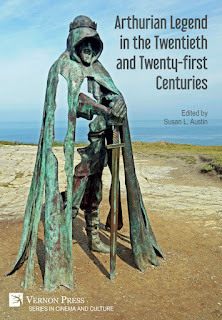
New Book: Arthurian Legend in the Twentieth and Twenty-first Centuries

New collection out now:

Arthurian Legend in the Twentieth and Twenty-first Centuries

Full details: https://vernonpress.com/book/1011 (plus intro and index)

Susan L. Austin (Ed.)

With contributions by Sarah Gordon (Utah State University), Carl Sell (Lock Haven University of Pennsylvania), Tracey Thomas (York University), Susan L. Austin (Landmark College), Zainah Usman (Tarrant Country College Northwest), Adrienne Major (Landmark College), Erin Mullally (Le Moyne College), Leah Hamilton (Xavier University)

Hardback $61 
Availability: In stock

also in E-book $ 75 , Paperback $ 48


SUMMARY

The King Arthur we imagine did not exist in history. He is the result of stories told and retold, changed and added to by storytellers for centuries, each making the story reflect the storyteller’s time and values.

The chapters in this book look at movies, manga, comic books, a television show, and traditional books released since 1960 to explore some of the ways King Arthur has been reimagined in the past 60 years. Interpreting Avalon High and The Kid Who Would Be King, Camelot 3000 and King Arthur vs. Dracula, Fate/Zero, John Steinbeck’s The Acts of King Arthur and His Noble Knights, the influence of Arthurian legend on Harry Potter, Terry Gilliam’s The Fisher King, John Boorman’s Excalibur, Jerry Zucker’s First Knight, Antoine Fuqua’s King Arthur, Guy Ritchie’s King Arthur: The Legend of the Sword, Matthew Vaughn’s Kingsman: The Secret Service, Iris Murdoch’s The Time of the Angels, and the BBC series Merlin, the authors find that while we are still interested in the idea of King Arthur, we may also want his story to be more racially and gender inclusive, less elitist, and in some cases, more secular.


TABLE OF CONTENTS

Introduction

Chapter 1
Kids and kings: postmodern nostalgia and youthful Arthurian cinematic retellings
Sarah Gordon
Utah State University

Chapter 2
Camelot 3000 and Dracula vs. King Arthur: The uses of limited-run comics as updates of the Arthurian legend for contemporary readers
Carl Sell
Lock Haven University of Pennsylvania

Chapter 3
The fate of Artoria: contextually exploring gender, character, and conflict in Fate/Zero
Tracey Thomas
York University

Chapter 4
Gender and class in John Steinbeck’s The Acts of King Arthur and His Noble Knights
Susan L. Austin
Landmark College

Chapter 5
A kid wizard in King Arthur’s court
Zainah Usman
Tarrant County College Northwest

Chapter 6
Chivalry and ambition in Terry Gilliam’s The Fisher King
Susan L. Austin
Landmark College

Chapter 7
Democratic dreams and the death of Arthur, king
Adrienne Major
Landmark College

Chapter 8
Killing Arthur: revising the Perceval myth in “Kingsman: The Secret Service”
Erin Mullally
Le Moyne College

Chapter 9
The death of the Fisher King in Iris Murdoch’s The Time of the Angels
Susan L. Austin
Landmark College

Chapter 10
When Arthurian heroes fall: adapting moral failure and Christian redemption in the BBC’s Merlin
Leah Hamilton
Xavier University

Index


EDITOR BIOGRAPHY


Susan Austin has worked at Landmark College, Vermont, for over a decade. There, she pursues her research interests, which include film adaptations of literature and modern and contemporary fiction. She teaches a course that uses Arthurian and related materials as sources for analysis and synthesis essays, and then sends students off to research and write about related topics in literature, history, archaeology, science, and popular culture. She holds an MA in English Literature from the University of Massachusetts at Amherst. Associate Professor Austin has presented several papers at the Northeastern Modern Language Association Conference in the last decade and she has chaired five sessions, one of which is the basis for this volume.

Wednesday, March 9, 2022

CFP Fair Unknowns: Extending the Corpus of Arthurian Texts (6/1/2022)


CFP Fair Unknowns: Extending the Corpus of Arthurian Texts


Sponsored by the Alliance for the Promotion of Research on the Matter of Britain


Collection edited by Carl Sell, Lock Haven University, and Michael A. Torregrossa, Independent Scholar.


Proposals due by 1 June 2022


The Arthurian tradition has existed for over 1500 years, yet we still know only the tip of the iceberg when it comes to the true size of the corpus of Arthurian texts. Many works from earlier periods have been neglected, and new works continue to appear each year. It is our contention that all of these can be as interesting as those texts continually turned to by Arthurianists; please, help us in expanding our view of the canon.


Call for Papers


Arthurianists excel at locating and cataloging representations of the Matter of Britain, and, as bibliographers, comicsographers, discographers, and filmographers, we have done much to expand our knowledge of the ways creators have made use of the tradition. However, our knowledge of the corpus still remains incomplete. An untold number of Arthurian texts from older eras remain missed by previous investigations (whether ignored, forgotten, or lost), while perhaps just as many are too new to have yet been the focus of critical analysis. Both omissions create unfortunate gaps in building a full history of the Once and Future King and those that surround him. A more complete picture of the reception of the legend is important for our understanding of how and why stories of Arthur and his court continue to be retold and can offer fresh insight to aid our teaching and research. The goal of this collection, then, is to create a nexus where the Arthurian past and present (and perhaps future) can meet in a space where we can set them into the larger context of the Matter of Britain and discuss and debate what makes them worth adding to the canon and how they can build and/or (re)shape of our critical understanding of Arthurian texts today.


Potential questions for discussion:

● Is it worth maintaining a canon of Arthurian texts?

● Are value-laden terms like “Lesser Arthuriana” useful critical tools?

● What Arthurian texts have yet to be discovered by scholars?

● What Arthurian texts have been unjustly neglected?

● What new Arthurian texts have been produced recently?

● How does your text fit into/engage with the larger Arthurian tradition?


Send inquiries, proposals, and/or drafts of papers to the organizers at KingArthurForever2000@gmail.com. We also welcome suggestions for resources (in print or online) that might be of value to the collection and its audience.


Sponsored Session - NeMLA Fair Unknowns


The 53rd Annual Convention of the Northeast Modern Language Association

Saturday, 12 March 2022 -- Track 17 (01:30-03:00 PM EST)

17.5 Fair Unknowns: Extending the Corpus of Arthurian Texts (Roundtable)


Sponsored by The Alliance for the Promotion of Research on the Matter of Britain (https://kingarthurforever.blogspot.com/)

Chairs: Carl Sell, Lock Haven University; Michael Torregrossa, Independent Scholar

Location: Dover A (Media Equipped)


Paper 1

"Gonzalo Torrente-Ballester's La saga/fuga de J. B. (1972): A Unique Arthurian Novel"

Juan Miguel Zarandona, University of Valladolid, Spain

In 1972, the Spanish writer Gonzalo Torrente Ballester (1910-1999) published a novel that surprised Spanish-language readers and that has been regarded as one of the ten best Spanish novels of the 20th century: La saga/fuga de J. B. Full of fantasy and provided with an acid sense of humour, it satirizes the long tradition of nationalist Galician writers whose texts that have been struggling to turn his home region, Galicia, into a full Celtic nation from the 19th century onwards in clear contrast with the rest of Spain. In other words, the matter of Britain or Arthurian legends had been made to take root in Galicia before, but never had such an ironic text as La saga/fuga de J. B. been published. Torrente Ballester was granted all possible Spanish literary prizes and rewards during his lifetime. He also enjoyed a strong popular reception thanks to film and television adaptations of his works. However, La saga/fuga de J. B., for example, has never been translated into English. It has only been translated into French and Portuguese. Consequently, it can be termed a fair unknown dealing with Arthur, Merlín or the Round Table beyond doubt. An Arthurian text that has been unjustly neglected by English-speaking audiences and denied inclusion in the corpus of English-language translated Arthuriana. This paper will make an attempt to remedy this neglect.


Juan Miguel Zarandona-Fernández. Doctor for the University of Zaragoza, Spain, in English Studies. Professor of the Department of Translation Studies, University of Valladolid at Soria, Spain. Teaching experience in English Studies and general and specialized translation: English-Spanish Legal and Business Translation. General research interests: Literary Translation, History and Translation, Cultural Studies and Translation. Specific research interests: Arthurian Studies, African Studies, Utopian Studies. Many papers and lectures in international conferences. Many articles, reviews, translations, book chapters, and research books published. Editor of the Hermeneus Review on Translation Studies. Editor of Vertere: series of monographs on Translation. Editor of Disbabelia: series on unknown translations (www.uva.es/hermeneus). Promoter of two research groups: Afriqana (www.afriqana.org) and Clytiar (www.clytiar.org).


Paper 2:

"Grail Knights and Green Lords: Gilles le Breton and the Knights of Bretonnia in Warhammer"

Carl Sell, Lock Haven University

Games Workshop and Black Library, the UK-based game producers and publication house of the Warhammer worlds, respectively, have never been shy about their appropriations of mythic contexts for their storylines in both the fantasy setting of the Warhammer Old World and the science fiction setting Warhammer 40,000. In fact, game designers and writers have worked together since the dual companies’ inception to craft coherent worlds that have mirror mythologies to our own with recognizable characters—sometimes in name, but mostly in deeds and in narrative arcs via the novels and tabletop game storylines. As Games Workshop and Black library are in the UK, it seems rather obvious that King Arthur, arguably Britain’s most famous mythic hero, should make an appearance in these settings as well. Indeed, Arthurian content is appropriated throughout the Warhammer worlds, but the most accessible analogue comes from Warhammer Fantasy’s Old World. The land of Bretonnia, a rough analogue of Britain and France rolled into one, is founded upon the principles of Arthurian kingship, as first set forth by Gilles le Breton, also called “Gilles the Uniter.” Gilles surrounds himself with his group of Companions, loyal warriors who fight by his side in his famous “Twelve Great Battles”—a legacy taken straight from Geoffrey of Monmouth and Nennius and given to Gilles, who is set up as the Arthurian figure of Bretonnia very early. Eventually, Gilles and his Companions meet “The Lady,” the lake goddess of Bretonnia, who shows them the Grail. Gilles rules Bretonnia in peace and unity until he is “killed” and sent across a lake to the Otherworld to dwell with the Lady, or so his Grail Knights believe. In reality, Gilles returns as the Green Knight, revealing his identity only during the End Times, when the Old World is overwhelmed by Chaos, and Bretonnia needs its greatest king once more. Warhammer clearly uses established Arthurian myth to ground its own character, Gilles, to create a narrative arc that not only makes sense to the Old World, but also feels familiar for players of the game and for readers of the novels. While the target audience is predominantly UK-based, Warhammer is growing ever more popular here in the US, and King Arthur is just as prevalent here and he is in his homeland. By using appropriated Arthurian material, I argue that Warhammer is able to rely on previously established narrative constructs to tell a familiar tale and use source texts that allow players and readers to feel a level of familiarity and comfort with the characters before they have ever opened a book.


Dr. Carl B. Sell is the TRIO SSS Interim Program Director at Lock Haven University. Carl’s research explores appropriations of Arthurian legend narratives, characters, and themes in popular culture as an extension of the medieval adaptive tradition. He serves as a member of the advisory boards for The Association for the Advancement of Scholarship and Teaching of the Medieval in Popular Culture and the Alliance for the Promotion of Research on the Matter of Britain, and he is the author of various film and literature reviews on medievalist and scholarly blogs and his own website, as well as journal articles and book chapters on Arthurian topics and DC’s Aquaman.


Paper 3:

"Once, Future, and Ongoing"

Hannah Montgomery, University of North Carolina at Chapel Hill

Calling BBC’s Merlin (2008-2012) wildly inaccurate is an understatement. Magic is illegal, Arthur was raised as a prince, Guinevere and Merlin are servants, Gwaine and Mordred are unrelated to Arthur, and Lancelot is long dead by the final battle. Stripping the legend of its Christianity, the Holy Grail becomes a relic of an outlawed, vaguely druidic “Old Religion.” But, do these inaccuracies matter? This beloved tale, with a fan base still actively calling for a sixth season or a movie, is still of a king and his knights trying to create a more just land and his death at the hands of one of his knights. After all, even authoritative Medieval texts vary widely, and some late Medieval romances are only “Arthurian” due to a brief appearance of Arthur, Lancelot, or Gwaine. Furthermore, the medieval Arthurian legend is likely a Welsh legend heavily influenced by French feudal court culture. Tennyson and White’s tales are widely accepted texts, although not part of the Medieval corpus, and both drastically update the material for their contemporary sensibilities.

I argue that, rather than a corpus of old texts, the Arthurian tradition is ongoing and constantly modifying the base story, with its questions of justice and loyalty, for the present ideals, allowing these virtues to be continually investigated and promoted through a familiar and beloved tale. Once and future, the story of Arthur’s attempt to make a more just kingdom, while navigating complex loyalties, is not medieval, but universal and ongoing.


Hannah Montgomery is a fourth-year Ph.D. candidate in the Department of English and Comparative Literature at the University of North Carolina at Chapel Hill. Her specialization is late medieval Middle English Romances, with a focus on questions of loyalty and friendship.


Paper 4:

"Perpetuating and Disrupting the Arthurian Canon: Portrayals of Morgan le fay and Merlin"

Rachael Warmington, Seton Hall University

I will examine how the ideals, laws, and anxieties of the societies in which the adaptations of Arthurian Legend were produced as well as variations in translations and blending of sources have led to the changes that have occurred in the representations of both Merlin and Morgan le Fay. These differences are clearly visible in Geoffrey of Monmouth’s “The life of Merlin,” Thomas Malory’s Le Morte Darthur, BBC’s television series Merlin as well as the comic book series Dark Knight of the Round Table, Unholy Grail, Dracula Versus King Arthur, and Wonder Women Second Genesis.


Rachael Warmington is an instructor at Seton Hall University. She earned her English B.A. from Montclair State University, English M.A. from Seton Hall University, her MFA at CUNY City College and is ABD at Indiana University of Pennsylvania. Rachael is the editor-in-chief of the academic journal, Watchung Review. She is also on the advisory board of the Association for the Advancement of Scholarship and Teaching of the Medieval in Popular Culture. Rachael is currently writing her dissertation which focuses on themes of Arthurian Legend in medieval texts and in contemporary literature, film and television adaptations and appropriations and how these themes create the space that challenges oppression in its various forms, but have also been used to perpetuate racism, sexism and religious intolerance.


Paper 5:

"Gawain Without the Sir in The Green Knight"

Susan Austin, Landmark College

In the 2021 film, The Green Knight, that Gawain’s name does not appear in the title as it does in the source it adapts, Sir Gawain and the Green Knight, is perhaps the first hint that this film is not what anyone familiar with the original would expect. This Gawain is not the model of chivalry that he is in the source, quite the opposite. In this film, he has to go on a dangerous quest – instigated by his mother – to learn honor and perhaps earn knighthood. This paper will explore how the film rewrites Arthurian legend to give women much more power and the Church much less.


Susan Austin is an associate professor of English at Landmark College, the premiere college for neuordiverse students. She edited and contributed to Arthurian Legend in the Twentieth and Twenty-first Centuries, a collection of essays based on her 2018 NeMLA round table. Her second edited volume, War, Espionage, and Masculinity in British Fiction, is also based on a NeMLA panel and due out this summer.