To me, methought, who waited with a crowd,
There came a bark that, blowing forward, bore
King Arthur, like a modern gentleman
Of stateliest port; and all the people cried,
"Arthur is come again: he cannot die."

"Morte d'Arthur" (1842)
Alfred, Lord Tennyson

Tuesday, March 15, 2022

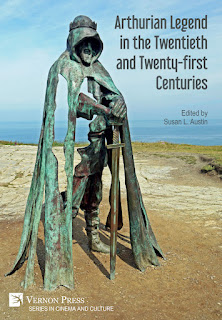
New Book: Arthurian Legend in the Twentieth and Twenty-first Centuries

New collection out now:

Arthurian Legend in the Twentieth and Twenty-first Centuries

Full details: https://vernonpress.com/book/1011 (plus intro and index)

Susan L. Austin (Ed.)

With contributions by Sarah Gordon (Utah State University), Carl Sell (Lock Haven University of Pennsylvania), Tracey Thomas (York University), Susan L. Austin (Landmark College), Zainah Usman (Tarrant Country College Northwest), Adrienne Major (Landmark College), Erin Mullally (Le Moyne College), Leah Hamilton (Xavier University)

Hardback $61 
Availability: In stock

also in E-book $ 75 , Paperback $ 48


SUMMARY

The King Arthur we imagine did not exist in history. He is the result of stories told and retold, changed and added to by storytellers for centuries, each making the story reflect the storyteller’s time and values.

The chapters in this book look at movies, manga, comic books, a television show, and traditional books released since 1960 to explore some of the ways King Arthur has been reimagined in the past 60 years. Interpreting Avalon High and The Kid Who Would Be King, Camelot 3000 and King Arthur vs. Dracula, Fate/Zero, John Steinbeck’s The Acts of King Arthur and His Noble Knights, the influence of Arthurian legend on Harry Potter, Terry Gilliam’s The Fisher King, John Boorman’s Excalibur, Jerry Zucker’s First Knight, Antoine Fuqua’s King Arthur, Guy Ritchie’s King Arthur: The Legend of the Sword, Matthew Vaughn’s Kingsman: The Secret Service, Iris Murdoch’s The Time of the Angels, and the BBC series Merlin, the authors find that while we are still interested in the idea of King Arthur, we may also want his story to be more racially and gender inclusive, less elitist, and in some cases, more secular.


TABLE OF CONTENTS

Introduction

Chapter 1
Kids and kings: postmodern nostalgia and youthful Arthurian cinematic retellings
Sarah Gordon
Utah State University

Chapter 2
Camelot 3000 and Dracula vs. King Arthur: The uses of limited-run comics as updates of the Arthurian legend for contemporary readers
Carl Sell
Lock Haven University of Pennsylvania

Chapter 3
The fate of Artoria: contextually exploring gender, character, and conflict in Fate/Zero
Tracey Thomas
York University

Chapter 4
Gender and class in John Steinbeck’s The Acts of King Arthur and His Noble Knights
Susan L. Austin
Landmark College

Chapter 5
A kid wizard in King Arthur’s court
Zainah Usman
Tarrant County College Northwest

Chapter 6
Chivalry and ambition in Terry Gilliam’s The Fisher King
Susan L. Austin
Landmark College

Chapter 7
Democratic dreams and the death of Arthur, king
Adrienne Major
Landmark College

Chapter 8
Killing Arthur: revising the Perceval myth in “Kingsman: The Secret Service”
Erin Mullally
Le Moyne College

Chapter 9
The death of the Fisher King in Iris Murdoch’s The Time of the Angels
Susan L. Austin
Landmark College

Chapter 10
When Arthurian heroes fall: adapting moral failure and Christian redemption in the BBC’s Merlin
Leah Hamilton
Xavier University

Index


EDITOR BIOGRAPHY


Susan Austin has worked at Landmark College, Vermont, for over a decade. There, she pursues her research interests, which include film adaptations of literature and modern and contemporary fiction. She teaches a course that uses Arthurian and related materials as sources for analysis and synthesis essays, and then sends students off to research and write about related topics in literature, history, archaeology, science, and popular culture. She holds an MA in English Literature from the University of Massachusetts at Amherst. Associate Professor Austin has presented several papers at the Northeastern Modern Language Association Conference in the last decade and she has chaired five sessions, one of which is the basis for this volume.

Wednesday, March 9, 2022

CFP Fair Unknowns: Extending the Corpus of Arthurian Texts (6/1/2022)


CFP Fair Unknowns: Extending the Corpus of Arthurian Texts


Sponsored by the Alliance for the Promotion of Research on the Matter of Britain


Collection edited by Carl Sell, Lock Haven University, and Michael A. Torregrossa, Independent Scholar.


Proposals due by 1 June 2022


The Arthurian tradition has existed for over 1500 years, yet we still know only the tip of the iceberg when it comes to the true size of the corpus of Arthurian texts. Many works from earlier periods have been neglected, and new works continue to appear each year. It is our contention that all of these can be as interesting as those texts continually turned to by Arthurianists; please, help us in expanding our view of the canon.


Call for Papers


Arthurianists excel at locating and cataloging representations of the Matter of Britain, and, as bibliographers, comicsographers, discographers, and filmographers, we have done much to expand our knowledge of the ways creators have made use of the tradition. However, our knowledge of the corpus still remains incomplete. An untold number of Arthurian texts from older eras remain missed by previous investigations (whether ignored, forgotten, or lost), while perhaps just as many are too new to have yet been the focus of critical analysis. Both omissions create unfortunate gaps in building a full history of the Once and Future King and those that surround him. A more complete picture of the reception of the legend is important for our understanding of how and why stories of Arthur and his court continue to be retold and can offer fresh insight to aid our teaching and research. The goal of this collection, then, is to create a nexus where the Arthurian past and present (and perhaps future) can meet in a space where we can set them into the larger context of the Matter of Britain and discuss and debate what makes them worth adding to the canon and how they can build and/or (re)shape of our critical understanding of Arthurian texts today.


Potential questions for discussion:

● Is it worth maintaining a canon of Arthurian texts?

● Are value-laden terms like “Lesser Arthuriana” useful critical tools?

● What Arthurian texts have yet to be discovered by scholars?

● What Arthurian texts have been unjustly neglected?

● What new Arthurian texts have been produced recently?

● How does your text fit into/engage with the larger Arthurian tradition?


Send inquiries, proposals, and/or drafts of papers to the organizers at KingArthurForever2000@gmail.com. We also welcome suggestions for resources (in print or online) that might be of value to the collection and its audience.


Sponsored Session - NeMLA Fair Unknowns


The 53rd Annual Convention of the Northeast Modern Language Association

Saturday, 12 March 2022 -- Track 17 (01:30-03:00 PM EST)

17.5 Fair Unknowns: Extending the Corpus of Arthurian Texts (Roundtable)


Sponsored by The Alliance for the Promotion of Research on the Matter of Britain (https://kingarthurforever.blogspot.com/)

Chairs: Carl Sell, Lock Haven University; Michael Torregrossa, Independent Scholar

Location: Dover A (Media Equipped)


Paper 1

"Gonzalo Torrente-Ballester's La saga/fuga de J. B. (1972): A Unique Arthurian Novel"

Juan Miguel Zarandona, University of Valladolid, Spain

In 1972, the Spanish writer Gonzalo Torrente Ballester (1910-1999) published a novel that surprised Spanish-language readers and that has been regarded as one of the ten best Spanish novels of the 20th century: La saga/fuga de J. B. Full of fantasy and provided with an acid sense of humour, it satirizes the long tradition of nationalist Galician writers whose texts that have been struggling to turn his home region, Galicia, into a full Celtic nation from the 19th century onwards in clear contrast with the rest of Spain. In other words, the matter of Britain or Arthurian legends had been made to take root in Galicia before, but never had such an ironic text as La saga/fuga de J. B. been published. Torrente Ballester was granted all possible Spanish literary prizes and rewards during his lifetime. He also enjoyed a strong popular reception thanks to film and television adaptations of his works. However, La saga/fuga de J. B., for example, has never been translated into English. It has only been translated into French and Portuguese. Consequently, it can be termed a fair unknown dealing with Arthur, Merlín or the Round Table beyond doubt. An Arthurian text that has been unjustly neglected by English-speaking audiences and denied inclusion in the corpus of English-language translated Arthuriana. This paper will make an attempt to remedy this neglect.


Juan Miguel Zarandona-Fernández. Doctor for the University of Zaragoza, Spain, in English Studies. Professor of the Department of Translation Studies, University of Valladolid at Soria, Spain. Teaching experience in English Studies and general and specialized translation: English-Spanish Legal and Business Translation. General research interests: Literary Translation, History and Translation, Cultural Studies and Translation. Specific research interests: Arthurian Studies, African Studies, Utopian Studies. Many papers and lectures in international conferences. Many articles, reviews, translations, book chapters, and research books published. Editor of the Hermeneus Review on Translation Studies. Editor of Vertere: series of monographs on Translation. Editor of Disbabelia: series on unknown translations (www.uva.es/hermeneus). Promoter of two research groups: Afriqana (www.afriqana.org) and Clytiar (www.clytiar.org).


Paper 2:

"Grail Knights and Green Lords: Gilles le Breton and the Knights of Bretonnia in Warhammer"

Carl Sell, Lock Haven University

Games Workshop and Black Library, the UK-based game producers and publication house of the Warhammer worlds, respectively, have never been shy about their appropriations of mythic contexts for their storylines in both the fantasy setting of the Warhammer Old World and the science fiction setting Warhammer 40,000. In fact, game designers and writers have worked together since the dual companies’ inception to craft coherent worlds that have mirror mythologies to our own with recognizable characters—sometimes in name, but mostly in deeds and in narrative arcs via the novels and tabletop game storylines. As Games Workshop and Black library are in the UK, it seems rather obvious that King Arthur, arguably Britain’s most famous mythic hero, should make an appearance in these settings as well. Indeed, Arthurian content is appropriated throughout the Warhammer worlds, but the most accessible analogue comes from Warhammer Fantasy’s Old World. The land of Bretonnia, a rough analogue of Britain and France rolled into one, is founded upon the principles of Arthurian kingship, as first set forth by Gilles le Breton, also called “Gilles the Uniter.” Gilles surrounds himself with his group of Companions, loyal warriors who fight by his side in his famous “Twelve Great Battles”—a legacy taken straight from Geoffrey of Monmouth and Nennius and given to Gilles, who is set up as the Arthurian figure of Bretonnia very early. Eventually, Gilles and his Companions meet “The Lady,” the lake goddess of Bretonnia, who shows them the Grail. Gilles rules Bretonnia in peace and unity until he is “killed” and sent across a lake to the Otherworld to dwell with the Lady, or so his Grail Knights believe. In reality, Gilles returns as the Green Knight, revealing his identity only during the End Times, when the Old World is overwhelmed by Chaos, and Bretonnia needs its greatest king once more. Warhammer clearly uses established Arthurian myth to ground its own character, Gilles, to create a narrative arc that not only makes sense to the Old World, but also feels familiar for players of the game and for readers of the novels. While the target audience is predominantly UK-based, Warhammer is growing ever more popular here in the US, and King Arthur is just as prevalent here and he is in his homeland. By using appropriated Arthurian material, I argue that Warhammer is able to rely on previously established narrative constructs to tell a familiar tale and use source texts that allow players and readers to feel a level of familiarity and comfort with the characters before they have ever opened a book.


Dr. Carl B. Sell is the TRIO SSS Interim Program Director at Lock Haven University. Carl’s research explores appropriations of Arthurian legend narratives, characters, and themes in popular culture as an extension of the medieval adaptive tradition. He serves as a member of the advisory boards for The Association for the Advancement of Scholarship and Teaching of the Medieval in Popular Culture and the Alliance for the Promotion of Research on the Matter of Britain, and he is the author of various film and literature reviews on medievalist and scholarly blogs and his own website, as well as journal articles and book chapters on Arthurian topics and DC’s Aquaman.


Paper 3:

"Once, Future, and Ongoing"

Hannah Montgomery, University of North Carolina at Chapel Hill

Calling BBC’s Merlin (2008-2012) wildly inaccurate is an understatement. Magic is illegal, Arthur was raised as a prince, Guinevere and Merlin are servants, Gwaine and Mordred are unrelated to Arthur, and Lancelot is long dead by the final battle. Stripping the legend of its Christianity, the Holy Grail becomes a relic of an outlawed, vaguely druidic “Old Religion.” But, do these inaccuracies matter? This beloved tale, with a fan base still actively calling for a sixth season or a movie, is still of a king and his knights trying to create a more just land and his death at the hands of one of his knights. After all, even authoritative Medieval texts vary widely, and some late Medieval romances are only “Arthurian” due to a brief appearance of Arthur, Lancelot, or Gwaine. Furthermore, the medieval Arthurian legend is likely a Welsh legend heavily influenced by French feudal court culture. Tennyson and White’s tales are widely accepted texts, although not part of the Medieval corpus, and both drastically update the material for their contemporary sensibilities.

I argue that, rather than a corpus of old texts, the Arthurian tradition is ongoing and constantly modifying the base story, with its questions of justice and loyalty, for the present ideals, allowing these virtues to be continually investigated and promoted through a familiar and beloved tale. Once and future, the story of Arthur’s attempt to make a more just kingdom, while navigating complex loyalties, is not medieval, but universal and ongoing.


Hannah Montgomery is a fourth-year Ph.D. candidate in the Department of English and Comparative Literature at the University of North Carolina at Chapel Hill. Her specialization is late medieval Middle English Romances, with a focus on questions of loyalty and friendship.


Paper 4:

"Perpetuating and Disrupting the Arthurian Canon: Portrayals of Morgan le fay and Merlin"

Rachael Warmington, Seton Hall University

I will examine how the ideals, laws, and anxieties of the societies in which the adaptations of Arthurian Legend were produced as well as variations in translations and blending of sources have led to the changes that have occurred in the representations of both Merlin and Morgan le Fay. These differences are clearly visible in Geoffrey of Monmouth’s “The life of Merlin,” Thomas Malory’s Le Morte Darthur, BBC’s television series Merlin as well as the comic book series Dark Knight of the Round Table, Unholy Grail, Dracula Versus King Arthur, and Wonder Women Second Genesis.


Rachael Warmington is an instructor at Seton Hall University. She earned her English B.A. from Montclair State University, English M.A. from Seton Hall University, her MFA at CUNY City College and is ABD at Indiana University of Pennsylvania. Rachael is the editor-in-chief of the academic journal, Watchung Review. She is also on the advisory board of the Association for the Advancement of Scholarship and Teaching of the Medieval in Popular Culture. Rachael is currently writing her dissertation which focuses on themes of Arthurian Legend in medieval texts and in contemporary literature, film and television adaptations and appropriations and how these themes create the space that challenges oppression in its various forms, but have also been used to perpetuate racism, sexism and religious intolerance.


Paper 5:

"Gawain Without the Sir in The Green Knight"

Susan Austin, Landmark College

In the 2021 film, The Green Knight, that Gawain’s name does not appear in the title as it does in the source it adapts, Sir Gawain and the Green Knight, is perhaps the first hint that this film is not what anyone familiar with the original would expect. This Gawain is not the model of chivalry that he is in the source, quite the opposite. In this film, he has to go on a dangerous quest – instigated by his mother – to learn honor and perhaps earn knighthood. This paper will explore how the film rewrites Arthurian legend to give women much more power and the Church much less.


Susan Austin is an associate professor of English at Landmark College, the premiere college for neuordiverse students. She edited and contributed to Arthurian Legend in the Twentieth and Twenty-first Centuries, a collection of essays based on her 2018 NeMLA round table. Her second edited volume, War, Espionage, and Masculinity in British Fiction, is also based on a NeMLA panel and due out this summer.


Saturday, March 5, 2022

Online Event: Art Break: Re-Imagining Medieval Camelot for Today (3/10/2022)

 This came across several lists last week:


Art Break: Re-Imagining Medieval Camelot for Today


Thursday, March 10, 2022, at 12 pm

ONLINE ONLY

Free | Advance sign-up required

Sign up


As a never-ending source of inspiration, the Middle Ages has been an indelible presence in many societies for centuries. Its rich history has captured creative minds who have re-told medieval narratives through words and images. Author of the New York Times bestselling series Camelot Rising, Kiersten White, and manuscripts curator Larisa Grollemond draw connections between medieval illuminated manuscripts and White’s adaptation and reinterpretation of medieval literature for young adult audiences—especially stories of King Arthur and the Knights of the Round Table. White and Grollemond discuss why medieval tales and imagery continue to have such resonance for contemporary audiences.

Saturday, October 30, 2021

Arthuriana for Summer 2021 on Race and the Arthurian Legend

 A belated post. 

The most recent number of Arthuriana (for Summer 2021) was a special issue on "Race and the Arthurian Legend." Further details ate available from the journal's website at http://arthuriana.org/access/31-2Contents.html. 


Table of Contents

(31.2)


Introduction  

Richard Sévère 3


The Fragile Giant 

Wan-Chuan Kao 9 


Romans, Celts, and ‘Others’: Residual Colonial Models and Race in Contemporary Arthurian Novel

Amelia A. Rutledge 40 


Writing Arthur’s Shadow and Speaking Otherwise  

Matthew Xavier Vernon 61


Broken Dreams: Medievalsim, Mulataje, and Mestizaje in the Work of Alejandro Tapia y Rivera

Nahir I. Otaño Gracia 77 


‘Many straunge synges and tokyns’: The Affective Power of Sir Thomas Malory’s Palomides

Kavita Mudan Finn 108 

An Arthurian Empire of Magic, and its Discontents: An Afterword

Geraldine Heng 124


THE ROUND TABLE:  

News and Notes from the North American Branch 139  

[ View Article ] [ Subscribers Only ]  


REVIEWS  

C. Girbea, M. Voicu, I. Panzaru, C. Anton, and A. Popescu, eds., Miroirs arthuriens entre images et mirages: Actes du XXXIVe Congrès de la Societé Internationale Arthurienne

Amy E. Brown 170


Ann Howey, Afterlives of the Lady of Shalott and Elaine of Astolat

Roger Simpson 171 


Anna Karin, Männliche Hauptfiguren im ‘Tristan’ Gottfrieds von Strassburg. Characterisierung, Konstellation und Red  

Charles Taggart 173 


Tim William Machan and Jón Karl Helgason, eds., From Iceland to the Americas: Vinland and Historial Imagination

David F. Johnson 175 


Joanne Parker and Corinna Wagner, eds., The Oxford Handbook of Victorian Medievalism  

Kevin J. Harty 177 


Thursday, August 19, 2021

CFP Fair Unknowns: Extending the Corpus of Arthurian Texts (9/30/21; NeMLA Baltimore 3/10-13/2022)

CFP Fair Unknowns: Extending the Corpus of Arthurian Texts


Sponsored by the Alliance for the Promotion of Research on the Matter of Britain

For the 53rd Annual Convention of the Northeast Modern Language Association

To convene at the Baltimore Marriott Waterfront, Baltimore, Maryland, from 10-13 March 2022

Proposals due by 30 September 2021


The Arthurian tradition has existed for over 1500 years, yet we still know only the tip of the iceberg when it comes to the true size of the corpus of Arthurian texts. Many works from earlier periods have been neglected, and new works continue to appear each year. It is our contention that all of these can be as interesting as those texts continually turned to by Arthurianists; please, help us in expanding our view of the canon. 


Call for Papers


Arthurianists excel at locating and cataloging representations of the Matter of Britain, and, as bibliographers, comicsographers, discographers, and filmographers, we have done much to expand our knowledge of the ways creators have made use of the tradition. However, our knowledge of the corpus still remains incomplete. An untold number of Arthurian texts from older eras remain missed by previous investigations (whether ignored, forgotten, or lost), while perhaps just as many are too new to have yet been the focus of critical analysis. Both omissions create unfortunate gaps in building a full history of the Once and Future King and those that surround him. A more complete picture of the reception of the legend is important for our understanding of how and why stories of Arthur and his court continue to be retold and can offer fresh insight to aid our teaching and research. The goal of this panel, then, is to create a nexus where the Arthurian past and present (and perhaps future) can meet in a space where we can set them into the larger context of the Matter of Britain and discuss and debate what makes them worth adding to the canon and how they can build and/or (re)shape of our critical understanding of Arthurian texts today.


Potential questions for discussion:

  • Is it worth maintaining a canon of Arthurian texts? 

  • Are value-laden terms like “Lesser Arthuriana” useful critical tools?

  • What Arthurian texts have yet to be discovered by scholars?

  • What Arthurian texts have been unjustly neglected?

  • What new Arthurian texts have been produced recently?

  • How does your text fit into/engage with the larger Arthurian tradition?


Submissions should be made directly into NeMLA’s conference management program at https://www.cfplist.com/nemla/Home/S/19480. Potential presenters will need to create an account with NeMLA to submit a proposal (including a presentation title, brief abstract--not more than 250 words--of some talking points addressing our major questions, academic bio, and AV needs)and to become members of NeMLA should their proposal be accepted for the session. Notice of acceptance will be made after 1 October 2021. Please go to the website nemla.org for details about session types and presenter guidelines.


Please address any other questions to the session organizers at KingArthurForever2000@gmail.com. We also welcome suggestions for resources (in print or online) that might be of value to the panel and its audience. 


Friday, July 30, 2021

Online Event: SWORD STONE TABLE: King Arthur’s Court Reenvisioned 8/3/2021

Hoping this works. The original is complex.


SWORD STONE TABLE: King Arthur’s Court Reenvisioned

August 3 • 7:00 pm - 8:00 pm


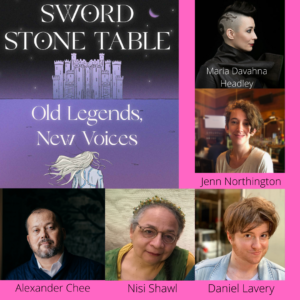
Featuring Sword Stone Table: Old Legends, New Voices editor Jenn Northington and contributors Alexander Chee, Maria Davahna Headley, Daniel Lavery and Nisi Shawl in conversation with Dr. Dorsey Armstrong

With A Connecticut Yankee in King Arthur’s Court, Mark Twain gave his own time travel twist to the Arthur legend. With Sword Stone Table, a whole new generation of writers bring their own takes on Arthur, Merlin, Mordred, Guinevere ,and Lancelot.

From the vast lore surrounding King Arthur, Camelot, and the Knights of the Round Table, comes an anthology of gender-bent, race-bent, LGBTQIA+ inclusive retellings. Here you’ll find the Lady of the Lake reimagined as an albino Ugandan sorceress and the Lady of Shalott as a wealthy, isolated woman in futuristic Mexico City; you’ll see Excalibur rediscovered as a baseball bat that grants a washed-up minor leaguer a fresh shot at glory and as a lost ceremonial drum that returns to a young First Nations boy the power and the dignity of his people. There are stories set in Gilded Age Chicago, ’80s New York, twenty-first century Singapore, and space; there are lesbian lady knights, Arthur and Merlin reborn in the modern era for a second chance at saving the world and falling in love—even a coffee shop AU.

Brave, bold, and groundbreaking, the stories in Sword Stone Table will bring fresh life to beloved myths and give long-time fans a chance to finally see themselves in their favorite legends.

Sword Stone Table features stories by:

Alexander Chee • Preeti Chhibber • Roshani Chokshi • Sive Doyle • Maria Dahvana Headley • Ausma Zehanat Khan • Daniel M. Lavery • Ken Liu • Sarah MacLean • Silvia Moreno-Garcia • Jessica Plummer • Anthony Rapp • Waubgeshig Rice • Alex Segura • Nisi Shawl • S. Zainab Williams

FREE program, but donations are gratefully accepted. REGISTER HERE.

Copies of Sword Stone Table signed by the editorsare available for purchase through the Mark Twain Store; proceeds benefit The Mark Twain House & Museum. Books will be shipped after the event. We regret that we are NOT able to ship books outside the United States as it is cost-prohibitive to do so.

————————–

About the Editors & Authors:

Swapna Krishna: https://www.swapnakrishna.com/bio

Jenn Northington: https://jennirl.com

Alexander Chee: https://www.alexanderchee.net

Maria Davahna Headley: https://www.mariadahvanaheadley.com

Nisi Shawl: http://www.nisishawl.com

Daniel Lavery: https://slate.com/author/danny-m-lavery


Our moderator: Professor Dorsey Armstrong


Professor Dorsey Armstrong—a specialist in medieval English literature—joined the Purdue faculty in 2002, where she currently serves as Head of the English Department. The holder of an A.B. in English and Creative Writing from Stanford University and a Ph.D. in Medieval Literature from Duke University, she also taught at Centenary College of Louisiana and at California State University, Long Beach. Her research interests include medieval women writers, late-medieval print culture, and the Arthurian legend, on which she has published extensively. In addition to numerous articles published in journals such as Exemplaria and Arthurian Literature, chapters in various academic books, and serving as co-editor for several scholarly essay collections, she is the author of Gender and the Chivalric Community in Malory’s Morte d’Arthur (University Press of Florida, 2003), Sir Thomas Malory’s Morte Darthur: A New Modern English Translation Based on the Winchester Manuscript (Parlor Press, 2009) and Mapping Malory: Regional Identities and National Geographies in Le Morte Darthur (Palgrave Macmillan, 2014; co-authored with Kenneth Hodges). In January 2009, she became editor-in-chief of the academic journal Arthuriana, which publishes the most cutting-edge research on the legend of King Arthur, from its medieval origins to its enactments in the present moment.

Winner of numerous teaching awards—including Purdue’s Murphy Award for Excellence in Undergraduate Instruction—Professor Armstrong has also written and taped several lecture series for The Teaching Company/The Great Courses. These include: “The Medieval World”; “Turning Points in Medieval History”; “Analysis and Critique: How to Engage With and Write About Anything”; “Great Minds of the Medieval World”; “1215: A Year That Changed History”; “King Arthur: History and Legend”; and “The Black Death: the World’s Most Devastating Plague.” Additionally, she has produced two short lecture series for Audible–one on “Powerful Medieval Women” and another on “Medieval Myths and Mysteries.” She currently sits on the executive and advisory boards for numerous scholarly and academic entities, the Bonnie Wheeler Fellowship, and the International Arthurian Society. She is currently at work editing a volume on Approaches to Teaching the Arthurian Tradition for the Modern Language Association.


Programs at The Mark Twain House & Museum are made possible in part by support from the Connecticut Department of Economic and Community Development, Office of the Arts, and the Greater Hartford Arts Council’s United Arts Campaign and its Travelers Arts Impact Grant program, with major support from The Travelers Foundation. For more information call 860-247-0998 or visit marktwainhouse.org

Friday, July 23, 2021

CFP Interdisciplinary Approaches to the Brut (9/15/21; ICMS 2022)

Interdisciplinary Approaches to the Brut-ICMS 2022

deadline for submissions: 
September 15, 2021
full name / name of organization: 
International Lawman's Brut Society

This session calls for papers that explore ways to incorporate the Brut—Layamon’s Brut and its analogues—into interdisciplinary studies, seeking to situate the Brut in a broader academic and pedagogical context.  How can the Brut, a text that has traditionally defied categorization, provide a way to introduce the interdisciplinary nature of medieval studies?  How might different disciplinary approaches broaden the appeal of a medieval historical poem to twenty-first century students and readers?  The session encourages proposals on teaching the Brut as part of an interdisciplinary curriculum.  We welcome studies that combine traditional academic disciplines, such as history, literature, and art, but we also look for papers that approach the Brut from new perspectives, including, for instance, media and popular culture studies.  

Please submit proposals (250-300 word) to the ICMS submissions website (https://icms.confex.com/icms/2022am/cfp.cgi) by September 15.

Please direct any questions to:

Kenneth Tiller

Professor of English

University of Virginia-Wise

kjt9t@uvawise.edu


cfp Language, Space, and Place in the Brut (9/15/21; ICMS 2022)

Language, Space, and Place in the Brut-ICMS 2022

deadline for submissions: 
September 15, 2021
full name / name of organization: 
International Lawman's Brut Society

Scholarship on the Brut has begun to reexamine the role of space and place in the text’s presentation and readers’ reception of insular history.  The Brut texts provide fertile grounds for such discussions, as much of the legendary history documented in the Brut involves reshaping and redefining insular territory, including descriptions of the island and its wonders, the construction of cities and castles, the renaming of places and cities by rulers and conquerors, among others.  This session seeks proposals that further the critical conversation about territorial and textual space and its relation to language in the Brut and in its analogues.  We are particularly interested in proposals that examine ways the Brut texts engage medieval concepts of space and place: how is space defined, perceived, and navigated in the Brut?  How does Layamon’s own sense of place or space inform his identity?  Possible topics include: local space in the Brut, boundaries and territorial limits, text as space, Layamon in his West-Midlands context. 

Please submit proposals (250-300 word) to the ICMS submissions website (https://icms.confex.com/icms/2022am/cfp.cgi) by September 15.

Please direct any questions to:

Kenneth Tiller

Professor of English

University of Virginia-Wise

kjt9t@uvawise.edu


Sunday, July 18, 2021

Arthuriana Spring 2021 Contents


The latest issue:

Arthuriana, Vol. 31, No. 1

Spring 2021

Source: http://www.arthuriana.org/access/31-1Contents.html.

(The journal can be purchased from the press and viewed at Project MUSE. It is also archived on JSTOR behind a moving wall.)


Table of Contents

‘Truth as They Heard’: Fama in Sir Thomas Malory’s Le Morte Darthur  
Louis J. Boyle 3


The Second Coming of King Arthur: Conspirituality, Embodied Medievalism, and the Legacy of John F. Kennedy  

Ellie Crookes

32


The Romance Forests of Medieval Iceland  
Maj-Britt Frenze

56


Love out of Measure: Comparing Malory’s Palomides and Lancelot  
Dana Omirova

78


Winner of the ‘Fair Unknown’ Award
They ‘Laȝed . . . Þoȝ Þey Lost’: Laughter in Sir Gawain and the Green Knight  
Jennifer Fast

92


REVIEWS  
 
Simon Armitage, Pearl: A New Verse Translation  
Ryan Buchanan Allen 116


María Odette Canivell Arzú, Literary Narratives and the Cultural Imagination: King Arthur and Don Quixote as National Heroes
Juan Miguel Zarandona 117


Glenn D. Burger and Rory G. Critten, eds., Household Knowledges in Late-Medieval England and France  
Wesley Chihyung Yu 119


Benjamin A. Saltzman, Bonds of Secrecy: Law, Spirituality, and the Literature of Concealment in Early Medieval England  
Craig R. Davis 121


Charles Russell Stone, The roman de toute chevalerie: Reading Alexander Romance in Late Medieval England  
Su Fang Ng 122